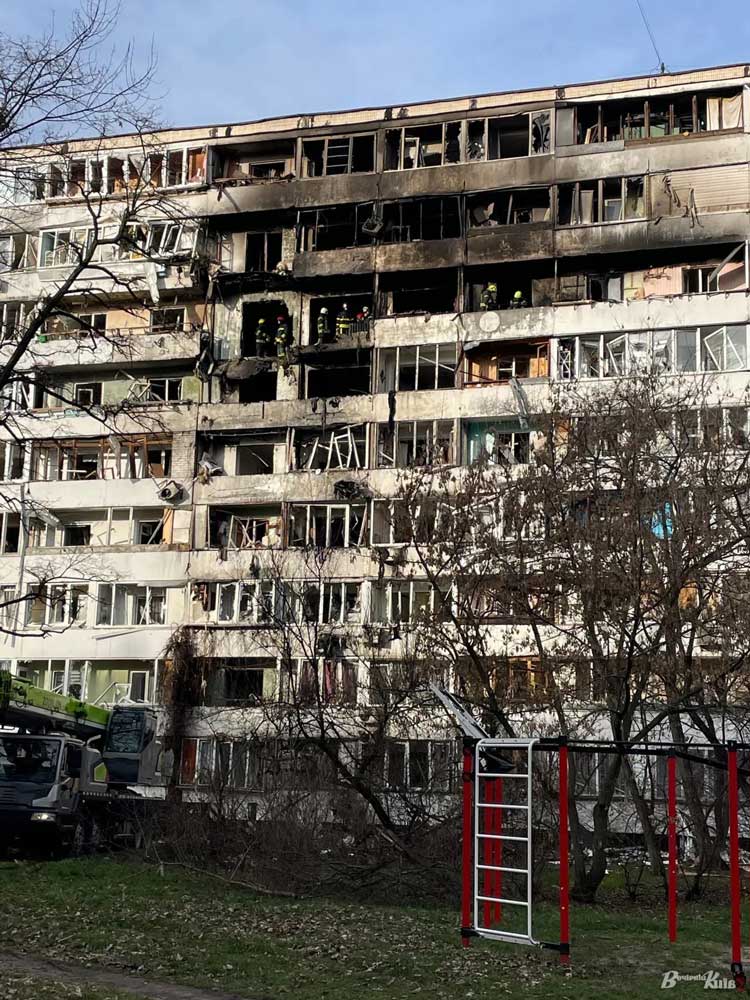
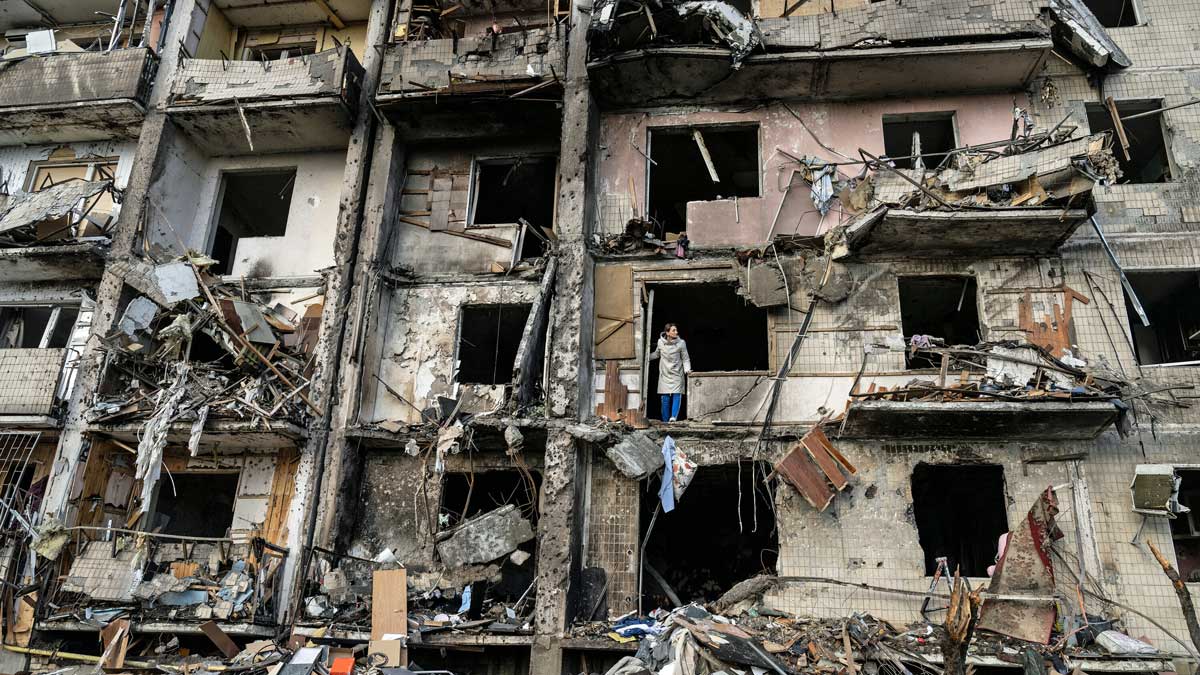
When you’ve been the target of murder every day and every night for the past nearly four years you don’t just suddenly drop the habitual expectation of violent attack. Even after crossing the ocean, your state of mind, body, and nervous system preserve patterns you’ve developed to survive and function.
My fear is real. In the absence of its usual sources it latches onto whatever else is around: my parents, driving, damaging their cars, spoiling their moods, etc. These genuinely nice people must be genuinely perplexed that I respond to their kindness with bristles.
My fear is real. In the absence of its usual sources it latches onto whatever else is around: my parents, driving, damaging their cars, spoiling their moods, etc. These genuinely nice people must be genuinely perplexed that I respond to their kindness with bristles.
Before you suggest that I show signs of PTSD and encourage me to rest and practice self-care (always valid advice), let me remind you that the sources of my stress and trauma are not at all past. I may be at a greater distance from the sites of russia’s missile strikes inside Ukraine, but this is a temporary reprieve from physical threat.
Nothing else has changed. In fact, it is only getting worse.
It keeps Ukrainians underslept and busy. Generators clatter and spew their fumes into the darkness. You change your eating habits as food storage and preparation are compromised. Mobile phone and Internet service become less reliable. We remain plugged in to modern civilization but have to continuously find new ways to make our customary routines work.
We talk about the power outage schedule and whether it’s fair that some buildings spend more time in the dark than others. We share how we cook, get wifi, and cope psychologically. My Ukrainian friends study how the power delivery system works and speculate about how it could be improved; debate ways to reform Ukraine’s ineffective approach to military mobilization; advocate for the armed forces and encourage fellow citizens to join; protest against government corruption and the concentration of power in a few individuals; discuss cultural policy and why its Soviet foundation still persists. I see these conversations peripherally without managing to participate in all of them.
Meanwhile the US Trump administration has been peddling a new “peace plan” to push for Ukraine’s capitulation and support Russia–US cooperation in making certain Americans richer. The US White House recently released an appalling new National Security Strategy. One doesn’t have to look hard to see that it lays out a worldview right in line with the Kremlin’s.
K H Hardy summed it up: “The White House has absorbed Moscow’s framing so completely that it cannot (or will not) distinguish between America’s national interest and that of Russia. This is a dangerous and counter-historical conflation.”
Last week I was overjoyed to meet Katja in Connecticut. First thing I did was bemoan that I feel so invisible here. My every action (writing, translating, fundraising, reading, or catching up on sleep) is done in relation to the war where Ukraine is fighting to protect its distinct existence from russia’s unilateral aggression. (1)
Yet in the US, the war that is destroying the world that I love becomes a private matter. Either I make an effort to share, explain, and justify its validity to the conversation, or it silently takes up a lot of space in my mind. I am not very available to share in the personal joys and troubles of my American friends.
My people in the US undoubtedly care about the future of Ukraine. So Katja asked a logical, if difficult, question: “What would it look like if the people here [that you say don’t really understand Ukraine’s resistance] understood?” She listened as I tried one unsatisfactory answer after another.
Then it hit me: this lack of understanding isn’t something happening between you and me. It’s not about anything that a person here could say or do for me as an individual. If Americans as a whole were fighting to maintain their own democracy at home, and that resistance was visible and pervasive, from personal conversations to public space, then I would know they understand what Ukrainians are fighting for.
If Americans really understood what the stakes were in Ukraine’s desperate fight to save and protect its people, culture, and fragile democratic statehood from russia’s relentless assault, then they would not be sitting around in 2025 discussing the strange wording of Trump’s 28-point “peace plan” and that document would not be littered with grammatical constructs that are characteristic of Russian.
Last November, russian drones flew into Romania several times and some crashed in inhabited areas. russian drones have violated the NATO member state’s borders over a dozen times since 2022. Romanian parliament passed a law in May 2025 allowing drones in Romanian airspace to be shot down. On November 25, Romania scrambled four fighter jets, but they did not shoot the russian drones flying in NATO airspace.
Deutsche Welle reported on the public response in Romania:
“It’s incomprehensible,” commented a presenter on the Digi24 television channel: “The laws for shooting down drones were created, the orders were given, the soldiers had free rein, and yet this drone was not shot down.” Romanian Defense Minister Ionut Mosteanu, a staunch supporter of Ukraine and not normally one to hesitate, struggled to explain himself to the press. “We are not at war,” he said, “we cannot just shoot without thinking about the consequences.”
Meanwhile:
The US military has killed more than 80 people outside the territory of the US since September 2025, in what the Trump administration has called a “non-international armed conflict” with drug cartels. The suspected drug traffickers are not combatants, nor did they pose a lethal threat to US forces at the time they were killed.
No different from russia, the US under the Trump administration is boldly exercising its presumed impunity to carry out unilateral military attacks on its declared enemies. The digital law and policy journal Just Security explains how these US boat strikes violate both US and international law.
On September 2, the US military performed a “double tap” strike to fulfill Defense Secretary Pete Hegseth’s command to “kill everybody” onboard a boat suspected to be carrying drugs in the waters off the coast of Venezuela. Michael Sellers has published several detailed reports of the strike on Substack. After the initial boat strike, two survivors were spotted clinging to debris in the water. They were targeted by a follow-up strike, which violates the basic law against killing people who are shipwrecked, incapable of combat, and pose no direct threat to their killers. Sellers explained how each person involved in the chain of command and execution bore responsibility for this murder (according to US domestic law) or extrajudicial killing (according to international humanitarian law). Even in war, which this is not, the action would constitute a war crime.
Surreal is the realm of weird, menacing images that populate our dreams and nightmares. The word is a back-formation from Surrealism, an art movement that emerged in the early 20th century and captured my youthful American imagination at the turn of the millennium. Surrealism pulsed with sensual fascination. It was the domain of the intellect unbridled: “Dictated by the thought, in the absence of any control exercised by reason, exempt from any aesthetic or moral concern” (from the
Manifesto of Surrealism, 1924). (2)
Have too many of us Americans decided — intentionally or by default — that the world spinning out of control is too far gone? If the show put on by the Trump administration is beyond comprehension, “exempt from any aesthetic or moral concern,” is it too outrageous or disgusting to claim as my own and thus consider my responsibility?
Investigations and analysis are invaluable for creating a more detailed picture. But they do not substitute for calling things by their names and calling out what is wrong and reprehensible.
I condemn the way that the US is brazenly defying all existing laws to kill people, non-combatants, outside its own borders. It is part of an alarming 21st-century trend of powerful nations banking on impunity to act outside the law. It is the gross abuse of power by a nation’s leader to use national resources and military force for his personal agenda. It is a foreboding demonstration of how little protection individual humans have against lethal, military force wielded by people without scruples.
At night I read from Artur Dron’s recently published prose collection, whose title I’d translate as Hemingway Didn’t Know Squat (Гемінґвей нічого не знає). The 24-year-old poet volunteered for Ukraine’s defense in 2022 and served as an infantryman for three years. (3) He writes:
“You can talk about “Putin’s war” until you’re blue in the face, but if the soldiers receive orders to capture a city, they don’t have to torture, pillage, or commit atrocities. Even if Putin himself ordered them to rape and kill, a human would refuse. But they do these things, because they can. Even worse — because they want to. Worst of all — because they like it.”
Today I write to you from a country that is actively campaigning to destroy my home in Ukraine and my home in a world that respects rule of law, and human life and liberty. I was born in this country, my mind (and strong teeth) are formed by its culture.
My fellow Americans, you don’t have to give up your power to rule this country — unless you want to. You don’t have to follow the course of russia — unless you like it.
Notes & additional reading:
1. “We are war,” wrote Victoria Amelina in her posthumously published book
Looking at Women Looking at War. “We are war” encapsulates the way that Ukrainians have been perceived by people abroad since Russia launched its full-scale invasion.
Sasha Dovzhyk’s recent newsletter reminded me of this condition, where your identity is the subject/object of military action, and also that we, Ukrainians, are also lovers, caretakers, office workers, friends, and so much more. I hadn’t noticed that I’d forgotten.
2. Another piece of Andre Breton’s Manifesto of Surrealism (Secrets of the Magical Surrealist Art) echoes uncannily into our present moment:
“Just prior to the elections, in the first country which deems it worthwhile to proceed in this kind of public expression of opinion, have yourself put on the ballot. Each of us has within himself the potential of an orator: multicolored loin cloths, glass trinkets of words. Through Surrealism he will take despair unawares in its poverty. One night, on a stage, he will, by himself, carve up the eternal heaven, that Peau de l’ours. He will promise so much that any promises he keeps will be a source of wonder and dismay. In answer to the claims of an entire people he will give a partial and ludicrous vote. He will make the bitterest enemies partake of a secret desire which will blow up the countries. And in this he will succeed simply by allowing himself to be moved by the immense word which dissolves into pity and revolves in hate. Incapable of failure, he will play on the velvet of all failures. He will be truly elected, and women will love him with an all-consuming passion.”
3. Dron’s second collection of poems, written during his military service, was published in English as
We Were Here (translated by Yuliya Musakovska). In a
2025 interview, in response to the question, “What would you want Americans – particularly young American university students like mine – to know about Ukraine right now?” he said:
“I think the main thing is this understanding that when you are helping Ukrainians, you are also helping yourself. Ukrainians are not just protecting our country. Ukrainians are protecting all the civilized world, including America. I know that it’s hard to understand, to imagine because we have this ocean between us. We are very far from each other. But still, it’s such an existential war. It’s like Lord of the Rings: it’s just a war of darkness and light. And if Americans are on the side of light, they have to understand that helping Ukrainians is helping themselves.”
a Kind of Refugee is a reader-supported publication.
To receive new posts and support my work,
consider becoming a free or paid subscriber.
First published on akindofrefugee2022.substack.com
Shared via Creative Commons.
Views: 120