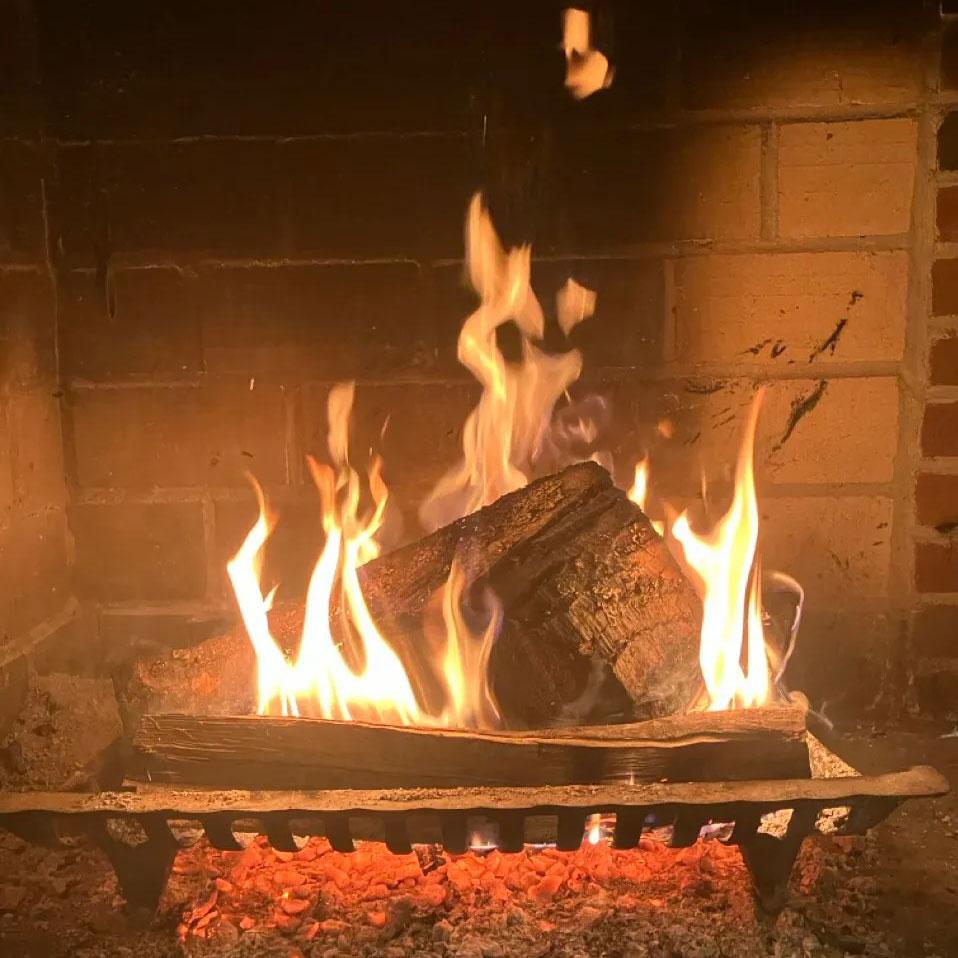
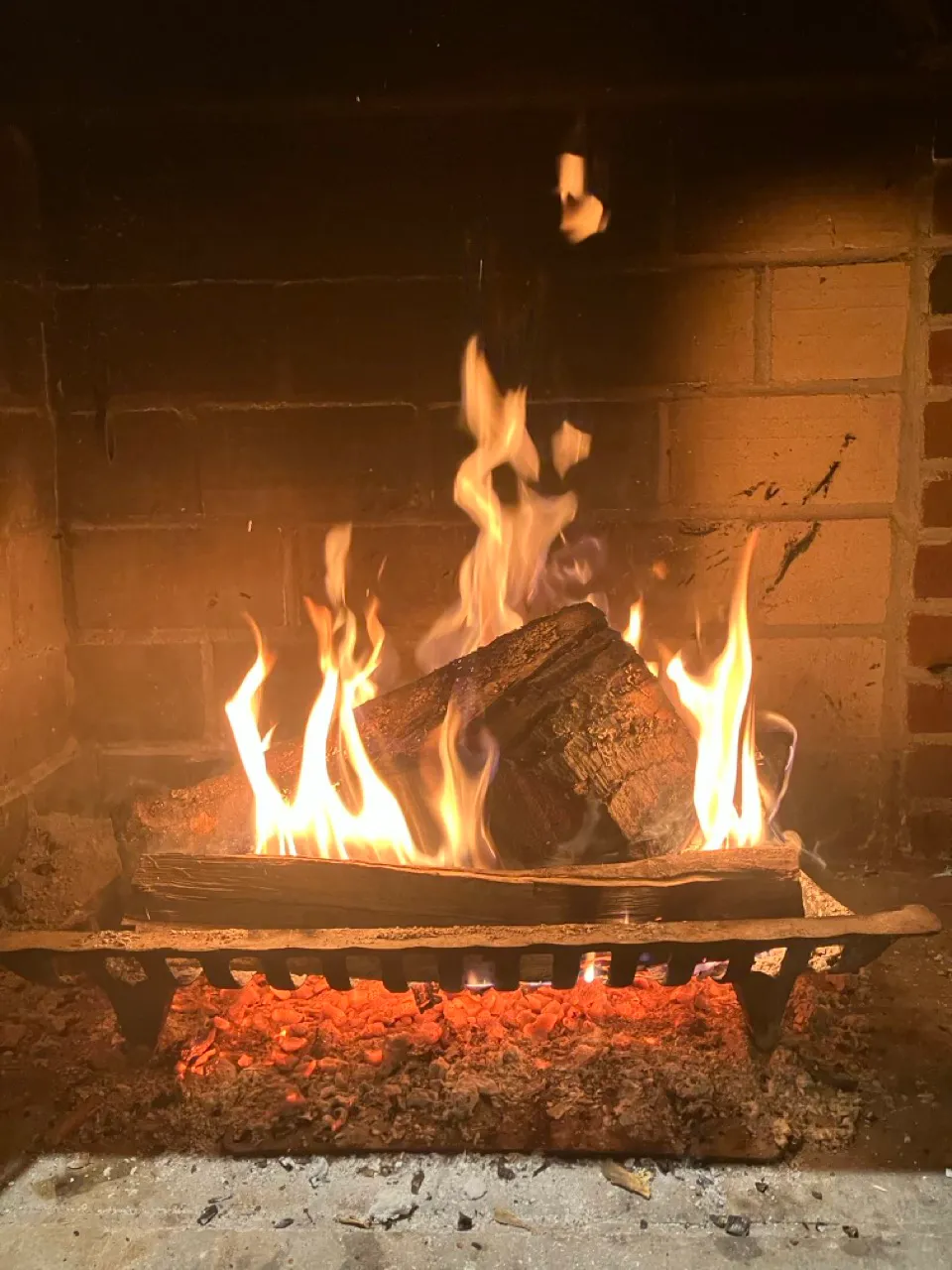
I do like a controlled fire. New England, late November 2025.
I remember her commenting, “This is so surreal,” and how that comment stung. I was offended that she could judge the very real conditions of my life for the past three years as being fantastical, beyond reality, the stuff of dreams (or nightmares).
Now it’s my turn: ladies and gentlemen of the West, this world of yours feels so surreal.
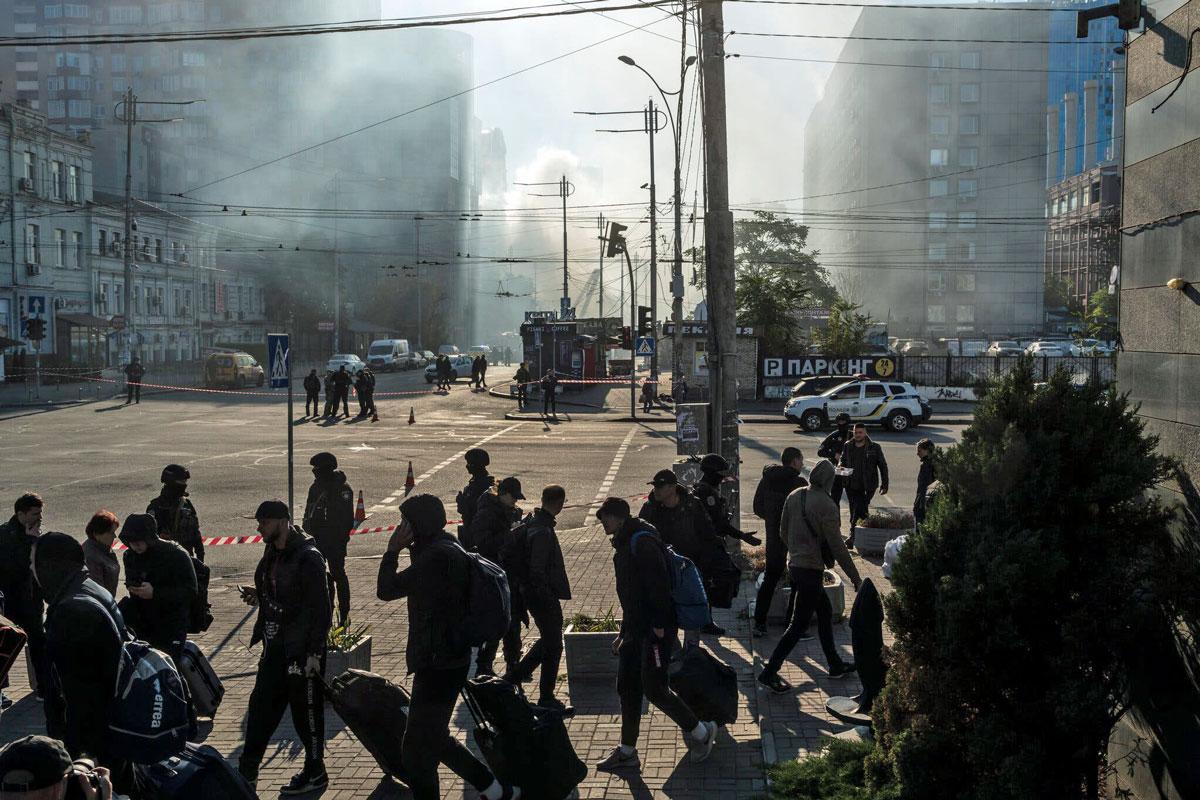
Just before boarding the plane in Warsaw I learned that an apartment building not far from my own had been struck by a russian Shahed drone overnight, setting fire to a couple floors. Two people were killed in their homes.
That this building was struck while my person was “safe” (to use the word you like so much) only deepens the ugly truth: I have failed to protect and secure my home, and I am unable to live my life in my home under current conditions of russian full-scale invasion.
I am also unable to live my life in somebody else’s home in the United States. “Surreal” marks the limit of my ability to bring my full experience into contact with my surroundings.
Every time my city and my neighborhood are battered by russian airstrikes, it hurts. If the challenges of daily life in a war zone soon distract me from whatever most recent attacks, then at a distance the pain and horror — against a background of continuous odious American political actions, while immersed in the American culture of self-involvement — linger longer.
Now instead of burdening the broken and over-stretched Ukrainian power grid I am a burden on the private resources of my family members. Their generosity is enormous. Accepting it this winter means acknowledging how I’ve failed both personally and politically. (Explaining how these two things are related would take a book.)
Last month I took notes on my routine-less existence in the ever-changing environment of unpredictable power cuts while preparing for a cross-continental journey.
Kyiv, November 20, around 4 PM. We should have had three hours of electricity today, but then emergency outages were instated. Five PM, the start of our scheduled power cuts is nigh approaching and a message on my phone says: “Emergency cuts are ending.” I’m sitting in my dusky apartment with eyes closed, for some reason in this light when I find myself in civilization without the appropriate instruments and infrastructure of civilization I need to close my eyes, to close off from this incomprehensible reality. I sit for a bit more. Then I decide. It is still better to leave and find a place with a generator to sit and do my internet computer things for an hour than just slip off into oblivion. I stand up. See the unwashed dishes in the candlelight. Candlelight is fine for washing dishes. I wash them. Then dress. Pack my backpack: powerbank and router cord for the evening meeting, my computer’s and phone’s power cords to recharge those, wallet, phone, headlamp, DON’T FORGET the laptop this time. Just as I’ve buttoned my jeans a subtle hum stirs the air. Could it be? Or am I just hallucinating that the refrigerator’s gone on. I flip the lightswitch and the room fills with light. Quick! Turn off the flashlight, blow out the candles, I’ll carry that heavy box of books downstairs after all, using the elevator! Unpack the laptop, plug in the power cord. Just as I head into the hallway to put on my shoes, I flip the switch and nothing happens. The apartment is quiet. The power is out again. Regroup: headlamp on, go back to the original plan. Laptop into bag. This time take the outlet transformer for the power cords (which I’d originally forgotten), wallet and phone go back in the backpack. And I don’t want to put off taking these books down to Nova Poshta. Who knows when I’ll have power tomorrow or Saturday, what else might happen between now and then. One less box in the house, one less urgent “thing to do” on my lists. The lamp is secure on my head, backpack strapped on, pick up the box and head for the stairwell. At the top of the stairs I pause. I remember putting my wallet and phone in my backpack, but I need to check to be sure. While I’m still on the same floor as my apartment. Put the heavy box down. Unstrap the backpack. Flip it to my front, open the little top pocket – phone, yes. Can I feel through to the wallet? No. Open the other part, find the wallet. Good to go. Close it all up and put it on and strap it in place and pick up the box and descend. One step at a time, imagine catching one foot on another and tumbling down five meters of concrete steps. Don’t imagine that, think of each foot making contact, deftly. Keep breathing.
This is the good life. Civilian city life. When your body and home are intact, your friends are okay, and your greatest trouble is descending seven flights of stairs by headlamp-light with two backpacks and a heavy suitcase before boarding a night train bound for the West.
I was in the European Union when a russian drone slammed into an upper-floor apartment of a residential building several buildings away from my own.
I sat in the plane before take-off, frantically typing on my phone. Replying to concerned friends that I’m not only unscathed, I’m in an EU airport! Trying to get a sense of what happened in my neighborhood while I am far away. Even my neighbors in my building could not reconstruct the night’s events from the sounds they heard, what they saw out the window, and the distribution of debris outside in the morning. Maintaining genuine, living bonds with communities in several different places inside and outside Ukraine is a complicated (and ultimately impossible) privilege.
It’s the gift of globalization. Hundreds of individuals sandwiched into a plane, ready for a cross-Atlantic flight, each on their own journey, with their own on-board entertainment system. We’ve all somehow agreed that almost everybody can deal with either chicken or pasta. What can I talk about with my fellow passengers if no major event happens to all of us at the same time? If nothing explodes, we are likely to remain as separate and untouched at the end of the flight as we were when we entered.
This is not theater.
A man sitting across the aisle keeps turning around to look at me. I can see the Russian words for “Welcome!” on his screen. He is lithe, friendly, and I imagine him in a gang in the 1990s, keeping order and following orders. I imagine he can still fight today and that he would win.
This man jokes with another Russian-speaking man who passes down the aisle, then waves at a man seated across the plane. I’m caught in a triangle of Russian-speaking men. They seem to know each other. And they’re all wearing tracksuits. (I’ve also been traveling since 3:30 AM, when I got into a cab in Warsaw — driven by a Russian-speaking man.)
A fantastical murder plot has seized hold of my imagination.
He must have heard me speaking Ukrainian when I called my neighbor in Kyiv. Maybe he’ll follow me when we exit the plane. Maybe he’ll run me off the highway outside the airport. I study his movements with apprehensive curiosity.
After a while I go to the bathroom. Reflected in the mirror is a “cute” Eastern European lady, who would surely catch the eye of a Soviet-born man who’s already had a couple drinks this morning. How silly to think his attention was that of an assassin.
But I am in no mood for casual chitchat. Or telling strangers that my faraway neighborhood was just attacked by Russian drones.
Is it really that strange that I should be wary — if not terrified — of Russian-speaking men?
PS December 6 is Ukrainian Armed Forces Day. These are the men and women who, regardless of how much (or how little) attention we are paying to them, continue to hold the line day in and day out, repelling constant russian attacks and pushing enemy occupiers out of Ukrainian lands. The number of my friends — both close and casual — serving in the AFU keeps growing, and they all could use our help. Please take a moment to remember and thank your friends defending Ukraine today! And please don’t hesitate to support the ongoing combat drone missions of my friends in the Birds of Fury via credit card or PayPal (he***************@***il.com).
a Kind of Refugee is a reader-supported publication.
To receive new posts and support my work,
consider becoming a free or paid subscriber.
Originally Published on AKindOFRefugee2022.substack.com.
Shared via Creative Commons.