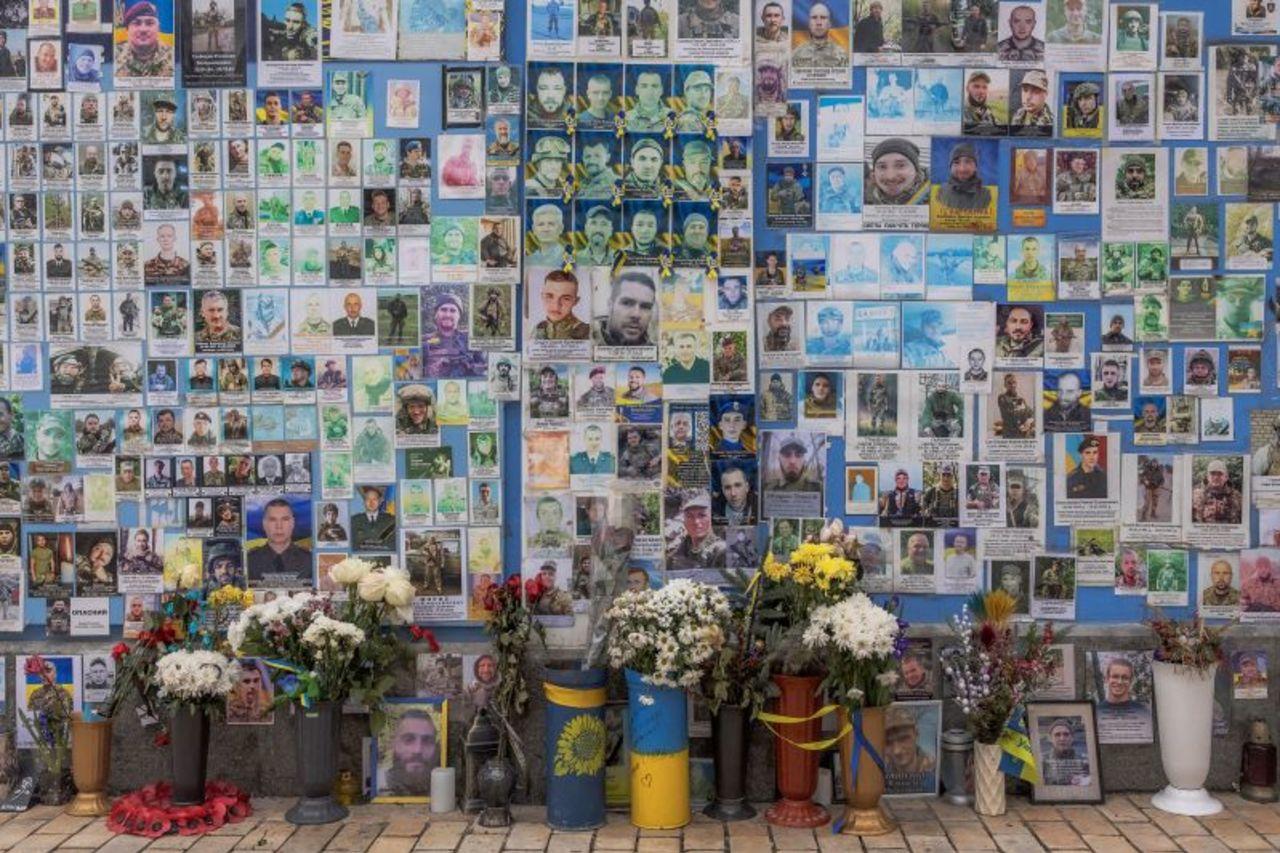

Last week, while interpreting for a group of foreign volunteers visiting Bucha and Irpin, where russian occupying forces committed war crimes and killed hundreds of residents in March 2022, I got to chatting with our Ukrainian tour guide. We talked about how Ukrainians’ custom of putting on a good face in the worst of circumstances can create an impression that life under russian genocidal attack is possible, even bearable.
Behold my weakness, dear readers. Maybe this will help you see beyond the heroic resistance of my fellow Ukrainians, and realize that their lonely perseverance in the face of russia’s campaign to destroy our homeland is a superhuman feat that no mortal being can endure indefinitely.
The foreign volunteers and I had just returned to Kyiv, after a morning remembering and visiting places where russian forces had indiscriminately murdered residents of Kyiv’s suburbs.
One German man approached me with a question. He wants to know my opinion on whether Ukrainians should go back to Ukraine.
Of course, I say, Ukrainians should be able to live in their own homes in their own country. russia should get the fuck out, so Ukrainians can live at home.
He: No, no, you don’t understand. We have these debates in Germany about sending the Ukrainians back . . .
Me: You want to deport them? Well, it’s your right to decide who to welcome into your country.
He is quiet for a moment, then: No, you don’t understand me.
Me: Look, Ukrainians would love to live in Ukraine, but russia is still attacking the country every single day. Yes, I live in Kyiv. I am still living in Ukraine because I haven’t been killed yet. What has changed? Why are Germans discussing sending the Ukrainians home now?
Three German guys look at me a bit uncomfortably. These volunteers drove for 36 hours to Kyiv to deliver much-needed vehicles for Ukraine’s armed forces. The air raid sirens over the two nights they’ve been here were not accompanied by airstrikes on the capital. Instead, russian drones pounded critical infrastructure in the Chernihiv region just to the north, leaving the entire city of Chernihiv and half the region without power, and glide bombs exploded in Kharkiv to the east.
He: Well we have this idea that Western Ukraine is more . . .
Me: I was in Lviv a few weeks ago — and so was one of your German MPs, visiting with some international delegation. There was a massive russian airstrike on the city, four civilians were killed.
It’s true: Desiree Becker, of the Left party (Die Linke), heard the explosions of russian drones and missiles from her basement shelter in central Lviv on October 4-5, passed the destroyed building where four civilians were killed the next morning, and still maintains the position that Germany should not supply weapons to Ukraine.
Sorry, guys, I have no way to resolve your “Ukrainian problem” without addressing russia. russia’s unilateral invasion of Ukraine and ongoing violence directed at every corner of the country is the reason why millions of Ukrainians are no longer living at home. If you’ve grown tired of their presence in Germany, you need to confront russia — and you’ll be doing yourself a favor in bolstering your own security too.
Home is practically an extension of your body, your person, your human being. The repetition of routine movements in the same space imprint themselves in your memory, while your actions leave traces on the physical surroundings, marking them as yours. Home is a place you can leave and return to with the reasonable expectation that it will still be there when you come back. Because it is familiar and consistent, you need not mobilize your entire sensory apparatus and nervous system in each and every moment the way you do when encountering something new, interesting, or dangerous. Your mind, body, and vital energies are free to address matters outside the home, to participate in the world shared by all humans.

I’ve come to my dear old friend Anka’s house to catch up on sleep and recover my wits.* In the quiet Polish countryside, I turn to another old friend for comfort and wisdom. Hannah Arendt’s essay, “On Humanity in Dark Times,”** is an enlightening reflection on friendship, compassion, and the space in-between individual human beings, for which we share responsibility, commonly known as “the world.”
The world becomes inhuman, inhospitable to human needs—which are the needs of mortals—when it is violently wrenched into a movement in which there is no longer any sort of permanence. (Arendt, p. 10–11)
Today russia’s ongoing, internationally enabled war against Ukraine is but one manifestation of a world alarmingly out of joint and spinning furiously out of control.
For over three and a half years, russia has been fucking with the natural vital rhythms of people in Ukraine with its regular, irregularly timed airstrikes.***
they’re playing with and on our expectations. you are primed for the next strike, waiting, and it doesn’t come, so you relish the bliss of a couple nights without interruption, oh how we love to sleep, and then bam, again. my visceral sense of timing is hard to keep in functioning order. because that does not depend on me. ‘that’ being the shit that they send into our skies. the explosive killer shit that they keep sending into our skies. (me, October 22, 2025)
While I’ve been reading, writing, and sleeping soundly in Poland. .
A woman in Kyiv died of injuries sustained in russia’s attack on the city on October 22, bringing the number of people killed in the capital that night to three, plus four in the Kyiv region, among them a six-month-old baby and a 12-year-old girl. russia used 28 missiles + 405 drones to attack Ukraine’s critical infrastructure, and also a kindergarten in Kharkiv.
The following night (while I was on a train to Poland) eight people across Ukraine were killed (and 69 injured) in a russian airstrike involving 130 drones. During the day on October 23, two Ukrainian journalists were killed by a russian drone in Kramatorsk. That night russia sent 128 drones into Ukraine. The next night, extending into the morning of October 25, russia launched nine ballistic missiles and 62 drones into Ukraine, killing two civilians in Kyiv and injuring 12. Over the weekend, into the morning of October 26, russia attacked with 101 drones, killing three civilians and injuring at least 32 (seven of them children) in Kyiv.
Last Friday, russia pummeled the southern city of Kherson with particular intensity. Enough that its stalwart residents (a fifth of the pre-2022 invasion population), accustomed to daily shelling, airstrikes, and the russian practice of hunting medical vehicles and civilians going about their business with FPV combat drones, took note. Michael Andersen’s matter-of-fact report from his friends in Kherson provides a sense of what it’s like to live in the city today.
Arendt, whose essay you can read in full online, acknowledges that there are times when the world (created and maintained by humans) becomes so inhuman and hostile to certain groups that they are compelled to withdraw. But she stresses the importance of remembering that this escape is actually an expression of the reality of the world as it is at the time.
How tempting it was, for example, simply to ignore the intolerably stupid blabber of the Nazis. But seductive though it may be to yield to such temptations and to hole up in the refuge of one’s own psyche, the result will always be a loss of humanness along with the forsaking of reality. (Arendt, p. 23, emphasis mine)
When I spend more time interacting with people outside Ukraine than with members of Ukraine’s armed forces, I sense a strain on my psyche. As if by prioritizing protecting my individual person, I may be sacrificing something of my humanity. This continuous tension is certainly in my power to regulate, if not fully control, like exercising muscle to prevent atrophy.
Last Sunday, I spoke to my friend Mariana over the phone. Kyiv was freshly wounded by russian airstrikes: five civilians had been killed over the weekend, emergency power cuts instated. Mariana told me the day was bright and sunny. It was an hour before we began to talk about what is always on our minds: our fellow Ukrainians killed by russia, some while defending us in battle, others inside their homes.
Mariana has a friend who does not want to leave Kherson. The friend has her reasons, and it’s home, after all. Mariana wants to get her friend out of the city that russia is mercilessly destroying. She can’t do it by force, and knows she will have to accept – and live with – her friend’s decision. But she cannot simply watch as russia expands its campaign of devastation and wait and see what happens.
Like many Ukrainians, Mariana understands with her whole person that in the theatre of war that is transforming our world, she is not a spectator, but a participant.
*I am profoundly grateful to my friend Anna Lazar and her mother Emilia, who have welcomed me into their home so many times that I feel at home here. Their hospitality made it possible to read Hannah Arendt and to write this piece.
*I am profoundly grateful to my friend Anna Lazar and her mother Emilia, who have welcomed me into their home so many times that I feel at home here. Their hospitality made it possible to read Hannah Arendt and to write this piece.
“On Humanity in Dark Times: Thoughts about Lessing,” an address on accepting the Lessing Prize of the Free City of Hamburg in 1959, originally written in German, translated by Clara and Richard Winston, from Hannah Arendt, Men in Dark Times, New York: Harcourt, Brace & Company, 1968, pp. 3–31.
Last night the air raid alarm in Kyiv lasted from 12:47–7:14 AM. russian airstrikes, involving 52 missiles and over 650 drones, were concentrated on Ukraine’s western Ivano-Frankivsk and Vinnytsia regions, the Kyiv region, and the south-eastern Zaporizhzhia region. At the moment of writing, three people have been reported killed and dozens injured in the attack.
PS My home in Kyiv and my person in Poland are still intact thanks to the tireless work of Ukraine’s Defense Forces. Since 2022, Help99 and the NAFO 69th Sniffing Brigade have been organizing donations of vehicles to Ukraine’s defenders. Volunteers from countries around the world join regular convoys to drive the vehicles to Kyiv, deliver them to members of the AFU, and see firsthand how Ukraine is still resisting russia’s invasion. You can help ensure a steady supply of vehicles by making a contribution: https://www.help99.co/convoys
First Published on a Kind Of Refugee.
Shared via Creative Commons.