Scene One
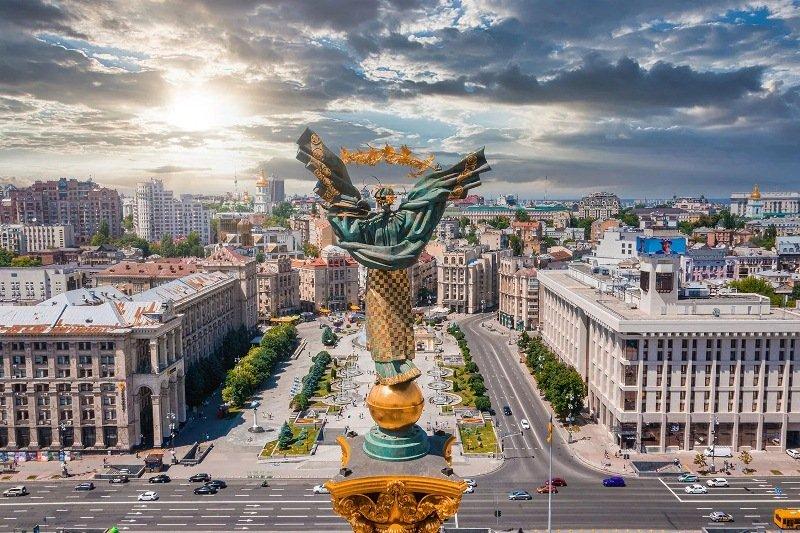
October, a Kyiv metro train. All the seats are full. I am reading Valeriy Puzik’s Myslyvtsi za shchastiam (Hunting for happiness) — a collection of sketches from his military service in parts of Ukraine deoccupied from russian forces. To my left is a woman, middle-aged, neatly dyed hair, with a bag on her lap, looking at her phone. To my right — a man around 40, salt-and-pepper hair, buzz cut, good-looking. The smell of alcohol hangs in the air.
I am reading a particularly graphic passage.
The man sitting next to me remarks, “Great book.”
“Yes, it is,” I agree. Has he seen what’s written on the page?
He maneuvers the open book so that both of us can see the pages at the same time.
“Someday we’ll read together,” he says. I am reading about the red and yellow stains on the sheet covering the corpse of a 20-year-old soldier the guys were asked to pick up from the field where it had been lying for three days.
“You know I’ve just bought a home with six rooms,” says the man. His breath reeks of alcohol; the boys in the book try not to puke from the smell of the corpse.
“I’ll shut up now and read.”
I get to the bottom of the page, close the book, and get up to exit at the next stop.
Scene Two
Friday, October 10, morning. russia bombarded Ukraine with 465 drones and over 30 missiles overnight, targeting elements of the power grid.
I wake up and discover the power is out. It’s a situation I’ve been in countless times before, only I’ve forgotten what it’s like. I flip the light switch in the bathroom out of habit. The toilet is still in the dark.
Friday evening, my apartment, candlelight. I have a work call with a Ukrainian colleague in another city.
“Sorry, I’m a bit low today,” I say.
“Why, did something happen?” she asks.
Me: “Oh, I’d forgotten what a pain it is to live without power.”
She tells me that in Shostka, where her brother lives, they’ve had power for 90 minutes a day since russia’s airstrikes on critical infrastructure in the Sumy region at the beginning of October.
She adds: “You know, a russian drone landed in my grandmother’s front yard last week. The house was badly damaged. Grandma wasn’t injured, thank God, just very shaken up.”
Scene Three
On October 4, russia attacked the train station in Shostka. A drone struck a train locomotive in the morning, and while evacuation was underway a second drone hit another passenger train. One person was killed on the spot, dozens were injured.
That day I was far across the country in Lviv. I’d come to the annual literary festival, BookForum, to spend some time with my colleagues and friends in person, and to read a couple poems by warrior poet Maksym Kryvtsov, killed in 2024, that Helena Kernan and I had translated.
That night I was asleep on a fold-out couch in my friend’s apartment when I heard knocking on the door. “Larissa, there are hundreds of Shaheds flying toward Lviv!” So what, I think, and keep sleeping. There is commotion in the apartment. It slowly dawns on me that my local hosts want me to join them the hallway, putting an extra wall between us and the explosions outside.
I have a public presentation the next day. Resting in a horizontal position wrapped in blankets is priority. There are large windows beside the bed, no curtains. When it gets loud outside I roll down into a small crevice on the carpeted floor between the bed and a couch. If the glass shatters, it will fall mostly on the higher surface of the bed, right? My spot on the floor is flat, warm, and feels safe.
Scene Four
After the Lviv BookForum, Kyiv, my apartment.
I read online that Ukrainian photographer George Ivanchenko and his close friend and mentor, photographer Antoni Lallican, were struck by a russian FPV drone while reporting from eastern Ukraine. Lallican was killed. George lost his leg. Both were wearing vests marked PRESS when they were hit.
It happened on October 3. While I was in Lviv, hopping from cafe to cafe, catching up with old friends, George was being transported to a stabilization point in the Donetsk region after being critically wounded.
George and I are Facebook friends; we’ve never met in person. His photos from reporting trips to Kharkiv, Sumy, Kherson and surrounding regions show apartment buildings on fire after russian airstrikes, rescuers moving civilians toward safety, hospitals with shattered windows, soldiers training in the woods. Within general scenes of destruction wrought by russia’s invasion, his lens gravitates toward people helping one another.
On October 8, he posted on Facebook in Ukrainian and English: “It was a targeted strike by an FPV drone. I’m alive. My leg was amputated.”
Scene Five
Night, Lviv, Kyiv, traveling cross-country on the Ukrzaliznytsia overnight train.
I read Hemingway to escape the events of the day. The main characters of The Sun Also Rises are always talking and joking and drinking. It’s the 1920s, they remember the Great War. Their spirit reminds me of the liveliness and seriousness of Ukrainians (and foreigners) I know who have been through war and military service.
I learn from Hemingway’s narrator that there is no word in Spanish that means “bull-fight.” They call it corrida de toros, literally “running of the bulls.” Twenty years after watching a bull-fight in Sevilla I finally get it: the “dance” between the torero and the bull, where the man uses his cape to lead the bull first one way, then another, is the art. It’s not about killing the bull. It’s about the way you make him run at you without killing you until he’s tired.
Scene Six
By now I have loads of experience listening to explosions—in my sleep, across the river, rattling the windows, overhead—and not being killed or injured. The nervous system learns through repetition. The body likes patterns, cycles, predictability. My intellect understands that my past experience is a poor indicator of future outcomes as long as I remain the target of russia’s ongoing genocidal attack.
You don’t have to be serving in Ukraine’s Defense Forces to be involved in this game of russian roulette. Four civilians were killed in that mass russian airstrike on Lviv. Still, the probabilities vary, depending on your proximity to russian forces.
Scene Seven
Anytime, online.
Read three poems by Ukrainian defenders published in English translation in the London Ukrainian Review. Eva Tur, Vasek Duknovskyi, and Valeriy Puzik all continue to write and make art while on active duty in Ukraine’s Defense Forces. Their voices attest to what is at stake in Ukraine’s fierce resistance to russia’s brutal, expanding war.
PS George Ivanchenko has a long recovery and rehabilitation ahead of him. Please contribute to his recovery fund (and look at his photos chronicling russia’s war against Ukraine on Facebook).
Credit card: https://send.monobank.ua/jar/6qRivvU8F9
PayPal: uk********************@***il.com
First published via A Kind Of Refugee.
Shared via Creative.Commons.